


Choosing the right sailing shell jacket starts with understanding how and where you’ll use it. Are you racing dinghies inshore, cruising coastlines, or pushing through offshore conditions? The ideal jacket strikes a balance between technical protection, layering compatibility, and comfort for your activity level.
At Zhik, innovation is built into everything we do. Our outerwear systems are developed through continuous R&D with elite sailors and tested in the world’s most demanding conditions. That’s why our range includes purpose-built jackets for every environment – from warm-weather inshore protection to four-layer ocean race shells.
Before diving into technical specs or jacket models, it’s crucial to understand the five key performance factors of a sailing shell:
- Waterproofness – how well the jacket repels water, rated by hydrostatic pressure
- Breathability – the ability for internal moisture vapour (from sweat) to escape
- Insulation – how much warmth the garment traps or generates
- Layering – how well it integrates with baselayers and midlayers
- Durability – the jacket’s resistance to repeated wear and harsh conditions
The right jacket will balance these elements depending on your sailing discipline and the environments you expect to face.

Waterproofness vs Breathability: Finding the Right Balance
Waterproofness keeps water out – essential when dealing with spray, rain, or waves. It’s measured using a hydrostatic head rating, which tells you how much water pressure a fabric can withstand before leaking. The higher the rating, the more resistant the jacket is to water ingress.
Breathability, on the other hand, allows internal moisture vapour (from sweat and heat) to escape through the fabric. Without it, your jacket will trap sweat, leading to clamminess and heat loss – especially in cooler conditions.
A high-performance shell does both: it blocks external water while allowing internal moisture to escape. That’s why every Zhik sailing jacket is engineered to balance waterproof membranes with breathable construction.
For inshore or dinghy use, prioritise breathability and mobility. For offshore or extended exposure, lean into maximum waterproofing and durability.

Understanding Waterproof Fabric Construction
Zhik sailing shells use either two-layer, three-layer, or four-layer fabric constructions. Each delivers a specific level of performance.
Two Layer Fabrics
Best for:
- Inshore and offshore cruising
- Moderate spray and rain
- Casual or entry-level use for that activity
Construction:
- Woven face fabric bonded to a waterproof membrane
- Inner mesh lining adds comfort and protects the membrane
Used in: INS100™ and OFS600™


Three Layer Fabrics
Best for:
- High performance Inshore racing
- Coastal and offshore sailing
- High-output activity
Construction:
- Face fabric + waterproof membrane + inner scrim lining
- Lightweight and durable, with no separate lining to trap moisture
Used in: INS200™, CST500™, OFS700™, OFS800™
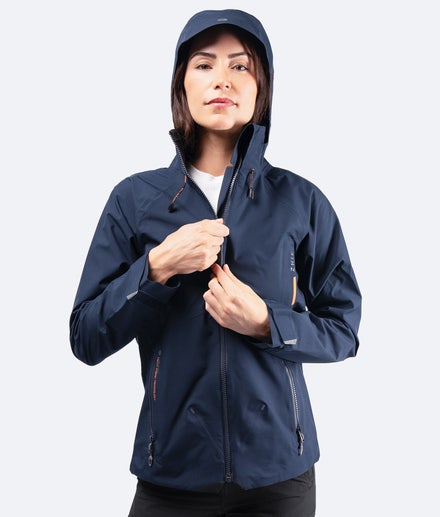


Four Layer Fabrics
Best for:
- Ocean racing
- Prolonged extreme conditions
- Heavy exposure to spray and waves
Construction:
- Dual-layer composite membrane system + scrim backing
- Highest level of durability, waterproofing, and breathability
Used in: OFS900™ Offshore Shell


Durable Water Repellent (DWR) Finishes
Every Zhik shell jacket is treated with a DWR coating that causes water to bead and roll off the fabric surface. This prevents saturation and keeps the jacket lighter and drier in wet conditions.
As part of our commitment to sustainability, Zhik is transitioning to XWR® coatings – a more environmentally responsible DWR alternative free from harmful fluorocarbons.

Insulation and Layering: Build Your System
Shell jackets don’t provide warmth on their own – they’re designed to work as part of a layering system. Your base and midlayers handle moisture wicking and insulation, while the shell protects from wind and water.
- For mild conditions: Pair a two-layer shell with a lightweight baselayer.
- For cold, wet conditions: Use a thermal midlayer beneath a three- or four-layer shell.
Example:
- INS100™ – Light insulation and waterproofing for inshore cruising. Pair with UVActive™ in warm weather or with a fleece in cool conditions.
- OFS800™ – Rugged outer shell for coastal/offshore use. Add a breathable fleece or Merino midlayer depending on the temperature.
Choosing the Right Jacket: Application First, Features Second
There is no single “best” sailing jacket – there’s only the best jacket for your needs. Here’s how to think about it:
- Inshore racing - Lightweight, breathable, flexible fit
- Coastal day sailing - 3-layer construction, moderate waterproofing, ergonomic cut
- Overnight / offshore passages - 3- or 4-layer shell, high waterproof rating, high neck / hood
- Ocean racing - Maximum waterproofness, high durability, layering compatibility
A sailing shell jacket is part of your larger system, and that system must match your conditions. Don’t evaluate jackets in isolation. Think about what you’ll be wearing underneath, how long you’ll be exposed to the elements, and how active you’ll be on deck.
Zhik’s modular apparel system allows you to pair the right shell with the right base and midlayer to stay warm, dry, and high-performing in any condition.